
Do you know how to identify finished ground level?
It is any surface that is situated near the base of the Boundary fence within 500mm of the Boundary Fence .
Below we see a retaining wall at the base of the left Boundary Fence.
The rear Boundary Fence generally has no retaining wall, except at the corner intersection.
In this location the rear Boundary fence measures only 1520mm.

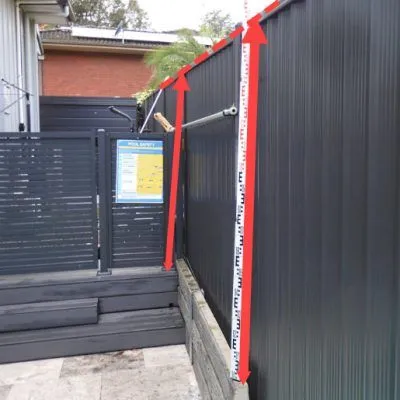
Here we see the pool constructed at a lower level to the Residence. The pool barrier is installed onto the upper level.
The Boundary Fence is installed at the lower level adjacent to the retaining wall. The retaining wall not only covers the base of the Boundary Fence but must be deemed ‘finished ground level’.

This configuration results in a fence height of 1700mm, which is too low under the current Standard.
Making Pools Safer, One Inspection at a Time
Book An InspectionIn this example, the raised ground level has reduced the effective height of the Boundary Fence to 1200mm.
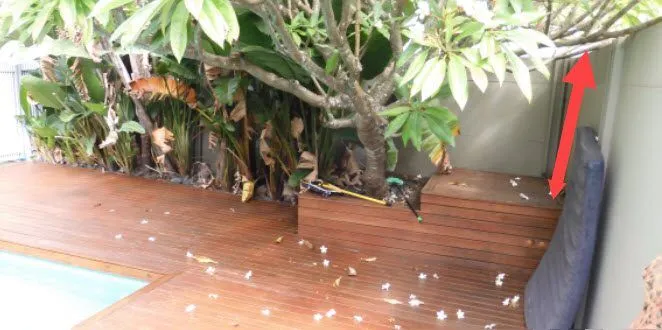
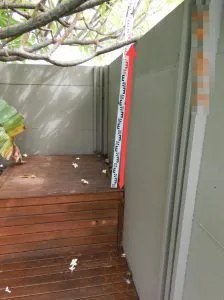
This low height may have been compliant under the old Standard (where height was measured from the neighbours’ side). However it does not comply now because height is measured from poolside.

In the example below the finished ground level has been raised by vertical posts
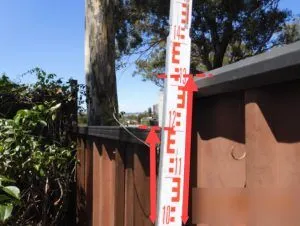
The posts greatly reduce the fence height to barely 1200mm as can be seen here. As has been noted this height may have been okay under the old Standard however when assessing under the current Standard the height is not compliant.
The fix for each of these scenarios is the same and a choice needs to be made.
Either lower the ground levels. Or increase the height of the fence accordingly.
In some Council areas, an increased fence height beyond 1800mm may not be permitted.
Always seek professional advice to learn how to increase the height of your Boundary Fence to ensure that new non-compliances are not created.
Remember to keep the upper 900mm Quadrant of your Boundary Fence free from protrusions, projections and indentations.