
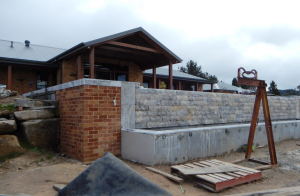
The swimming pool shown above is a semi in-ground infinity pool. The concrete skimmer catchment tank is located below pool level.
Whilst out-of-ground and infinity pools were approved in the past, in 2011 the Swimming Pools Act and Regulation was amended. It now refers to the Building Code of Australia rather than directly to AS1926. The owner of this newly constructed pool was unaware of the changes. His design configuration is no longer compliant in NSW due to the pool wall forming the pool barrier. Other states have not changed their Legislation. On top of that the planned fencing at pool pavement level would not have complied. It would have been traversable. The owner required the assistance of a professional to identify and resolve.
The Building Code of Australia
BCA “Part 3.9.3 applies in New South Wales to the technical construction requirements for barriers to restrict access to swimming pools. The affected pools are out-of-ground pool walls and the walls of above ground pools, including inflatable pools. The pool wall is no longer considered to be an effective barrier.
Note: The Swimming Pools Act 1992 and the Swimming Pools Regulation 2018, applicable to swimming pools with a depth of water of more than 300mm. The legislation regulates the circumstances in which a barrier is required and prevail in the case of any inconsistency”.
The changes described above preclude private certifiers from issuing compliance for any pool barriers which do not meet with the requirements of the Swimming Pools Act, Regulation, Standard or BCA.
But can you still want to build this type of pool? Firstly any construction requires a Building Certifier to sign off on the design configuration. This is to check that it does comply with the Legislation. Notwithstanding the rules, an A1/A2 Building Certifier technically has the authority to approve a design that does not comply with the Legislation but treat as ‘Performance-Based’ or ‘Deemed-To-Satisfy’. But when your Building Certifier is not willing to do that, you will then need to comply with AS1926.1-2012 and the Swimming Pools Act. That means you need to construct a compliant barrier that is not attached or a part of the pool structure.
Making Pools Safer, One Inspection at a Time
Book An InspectionThis is where an experienced E1 Certifier can assist. Our Certifier can review your plans, liaise with your Building Certifier to determine a compliant course of action for your specific configuration that will mean that in future any E1 Registered Swimming Pool Inspector is able to issue compliance, rather than relying on an A1/A2 Building Certifier to issue Compliance for the life of the pool.
So reach out to our Pool Compliance Inspector at Pool Certify
The information provided in this article is for general informational purposes only. While we strive to offer accurate and up-to-date content, it is not intended to replace professional advice. The publisher of this article cannot be held liable for the creation of any new non-compliances, a failure to comply issued by this or any other inspector, that may have resulted after reading and acting on the general information contained herein, or any damages, injuries, or losses that may result from the application of the information provided where the pool owner has not sought appropriate professional on-site advice prior to taking action.